Apple Published "Minions," a Virtual GPU Cloud Built on Idle Apple Silicon Macs--Six Apple Researchers Cut Ten-Hour Inference Queues to Minutes With the Macs Already on the Network, and Say Training Is Next
Apple published "Minions: A Dynamic and Distributed Virtual GPU Cloud Built on Idle Apple Silicon Devices" on Apple's Machine Learning Research site in October 2026, a three-page paper by six Apple researchers, Jianhua Li, Yun Xing, Girisha De Silva, Ryan Flint, Kai Yuan and Sean Suchter, submitted to arXiv on October 9. It describes a system used "across multiple teams" inside Apple: idle Apple silicon Macs on the network pull pieces of machine-learning inference jobs and run them on their own GPUs, and jobs that once waited more than ten hours for a central GPU "can often begin execution within minutes."
How the Minions divide the work
The Minion Server, "the central coordination layer of the system," validates a request and splits it into subtasks, with the state in a PostgreSQL store. A Minion Executor on each Mac fetches a subtask, downloads its inputs from Amazon S3, runs it on the Mac's GPU and writes the result back. For large language model completion it uses Ollama, "an open-source framework for running LLMs locally on macOS devices." Executors send a heartbeat every five minutes; when one goes quiet "due to network loss, device sleep, power-off, or intentional termination by the device user," the Minion Watchdog puts its unfinished subtasks back in the queue. Its table gives the before and after: GPU queue time from "Hours (up to 10+)" to "Minutes," new GPU requests from "Required" to "None," infrastructure cost from "High" to "Zero," scaling effort from "Manual" to "Organic."
What the paper does not say
It names no Mac model, no chip and no count of machines, and gives no throughput or latency figures. By our reading each subtask runs whole on one Mac, so a model must fit the Mac that draws it. The authors call data confidentiality "a common adoption concern" and answer it with team- or organization-scoped deployments on dedicated databases; heise reads that as workloads within organizations that trust each other. The next step, the paper says, is distributed training, and idle Macs federated across organizations or "the global community" "could form a massive, shared GPU resource pool."
The hardware it counts on
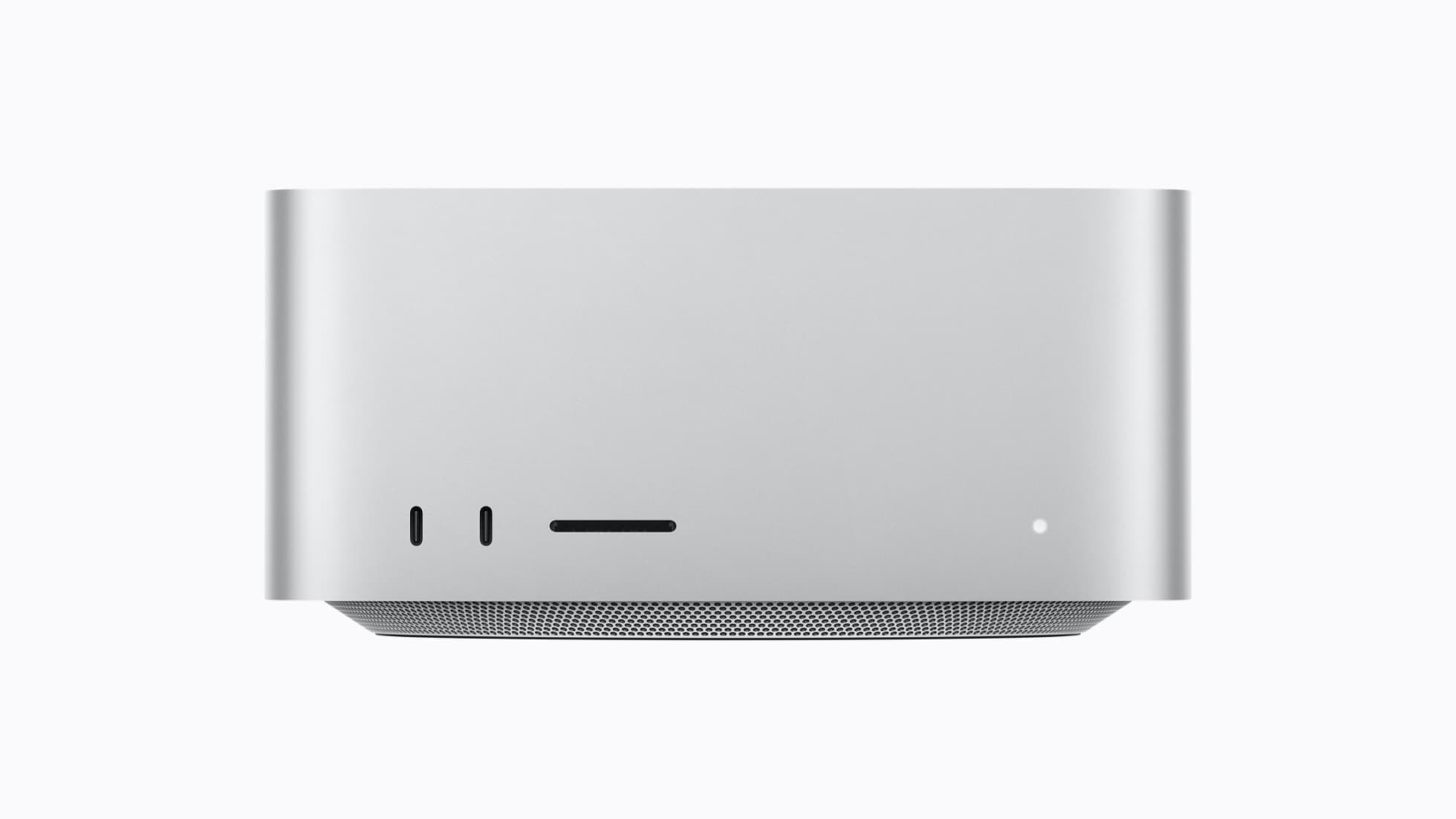
The GPU it harvests is in every machine on Apple's list of Macs with Apple silicon, from the 2020 M1 MacBook Air to the MacBook Neo. Apple's August 25 Mac Studio press release puts an up-to-80-core GPU and up to 512GB of unified memory in the $5,499 M5 Ultra model; the $899 M6 Mac mini of Apple's Mac mini press release of the same day has a 12-core GPU with a Neural Accelerator in each core, an M5-era feature that Apple's November 19, 2025 post on MLX and the M5 measured at up to four times an M4 for time to first token.
Then and now
The Mac's GPU used to be a card you bought: on October 17, 2000 we reported that ATI's Radeon for the Power Mac G4 had shipped. In January 2004 Apple's Xgrid preview promised that "whenever you aren't working, your Mac can crunch away at some data set," and our 1999 SETI@home note counted Macs at 12 percent of the work units. Minions is Xgrid's idea with Ollama in place of a screensaver, and we would like Apple's executor to ship in macOS some day.
Sources
- Apple, “Minions: A Dynamic and Distributed Virtual GPU Cloud Built on Idle Apple Silicon Devices - Apple Machine Learning Research” accessed Oct 17, 2026
The paper's listing on Apple's Machine Learning Research site, dated October 2026, with the title, the six authors Jianhua Li, Yun Xing, Girisha De Silva, Ryan Flint, Kai Yuan and Sean Suchter, and the link to arXiv; accessed October 17, 2026.
- arXiv, “[2610.12970] Minions: A Dynamic and Distributed Virtual GPU Cloud Built on Idle Apple Silicon Devices” accessed Oct 17, 2026
Submitted October 9, 2026 (v1); "3 pages, 1 figure, 1 table"; affiliation "Apple, USA"; the full text (arxiv.org/html/2610.12970v1): the Minion Server as "the central coordination layer of the system" handling parameter validation and the split into subtasks; a PostgreSQL metadata store; the Minion Executor running "on macOS devices equipped with Apple Silicon GPUs" that fetches eligible subtasks, downloads inputs from AWS S3 and uploads results; Ollama, "an open-source framework for running LLMs locally on macOS devices," for LLM completion; five-minute heartbeats; unresponsiveness "due to network loss, device sleep, power-off, or intentional termination by the device user" and the Watchdog reclaiming unfinished work; use "across multiple teams"; "some inference jobs experienced queue times exceeding ten hours" and "tasks can often begin execution within minutes"; Table 1's four rows (Hours (up to 10+) to Minutes, Required to None, High to Zero, Manual to Organic); data confidentiality as "a common adoption concern" and team- or organization-scoped deployments backed by dedicated PostgreSQL databases; future work on distributed training and the "global community" and "could form a massive, shared GPU resource pool" sentence; no Mac model, chip, device count, memory size, throughput or latency figure in the text; accessed October 17, 2026.
- heise online, “Apple researchers use idle Apple Silicon Macs as virtual GPUs | heise online” accessed Oct 17, 2026
October 15, 2026, Ben Schwan: the system currently handles workloads within organizations that trust each other; the wait of over ten hours reduced to minutes; accessed October 17, 2026.
- Ollama, “Quickstart - Ollama” accessed Oct 17, 2026
Ollama's own documentation: download Ollama for macOS, Windows or Linux and run a model locally from the terminal; accessed October 17, 2026.
- Apple Support, “Mac computers with Apple silicon - Apple Support” accessed Oct 17, 2026
Apple's list of Macs with Apple silicon, dated May 12, 2026, which runs from the M1 MacBook Air of 2020 to the MacBook Neo; accessed October 17, 2026.
- Apple Newsroom, “Apple introduces new Mac Studio with M5 Max and M5 Ultra - Apple” accessed Oct 17, 2026
August 25, 2026: the M5 Ultra's "up-to-80-core GPU"; up to 512GB of unified memory; the M5 Ultra model from $5,499; the press picture of the Mac Studio; accessed October 17, 2026.
- Apple Newsroom, “Apple unveils a more powerful Mac mini featuring the all-new M6 and M5 Pro - Apple” accessed Oct 17, 2026
August 25, 2026: the Mac mini with M6 from $899; the M6's 12-core GPU with Neural Accelerators in each core; accessed October 17, 2026.
- Apple, “Exploring LLMs with MLX and the Neural Accelerators in the M5 GPU - Apple Machine Learning Research” accessed Oct 17, 2026
November 19, 2025: "The GPU Neural Accelerators introduced with the M5 chip"; "up to 4x speedup compared to a M4 baseline for time-to-first-token"; accessed October 17, 2026.
Saw something? Send a tip or a correction
The archive ran on reader tips. What did you see, where, and do you want the credit? Something wrong on this page? Say so and it gets fixed.